
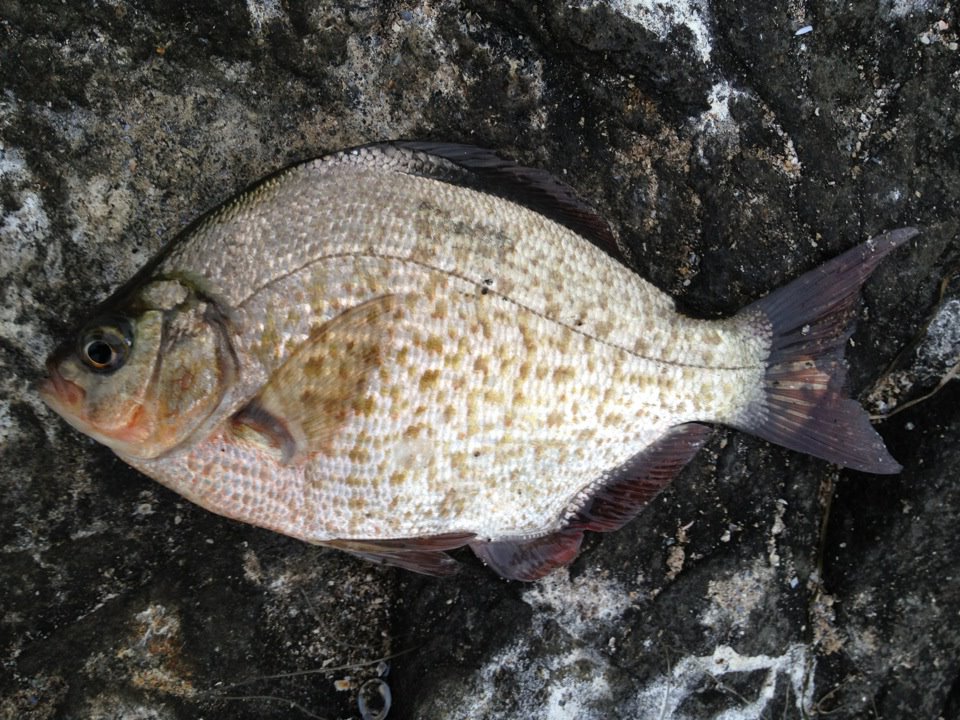
Species: Calico Surfperch (Ampistichus koelzi)
Location: Chetco River South Jetty, Brookings-Harbor, OR
Date: September 12, 2011
Misidentification is to fishing what the New England Patriots are to football: an unfortunate everyday reality that can’t be ignored.
Fortunately, just like tonight’s Patriots’ Super Bowl loss, good can get a foothold in the fight against evil and make that unfortunate everyday reality just a little quieter.
Every year, Oregonians flock to the South Coast to fish for “pinkfins” near the mouths of the Rogue, Umpqua, and Winchuk Rivers. Ask almost any angler, and they’re fishing for Redtail Surfperch. While the majority of “pinkfins” are actually Redtails, a substantial minority are Calico Surfperch — an entirely different species.

This post won’t be long, but I hope it is helpful. Where their range overlaps (Southern Oregon and Northern California), these two species often get lumped into the same “pinkfin” category. Just use this comparison to be able to tell they’re not.
That is, don’t just avoid being a part of the problem; be a part of the solution.
***
I caught my first Calico off of the jetty in Brookings. After striking out for Striped Surfperch on the river side, we followed the Biblical example and threw to the other side. I landed a Redtail and a Calico in an hour, proving these two species not only overlap ranges but overlap the same feeding grounds at the same time.
Since I thought they were different-looking enough, I took a photo with my disposable camera. After processing and comparing them side-by-side and doing some online research, I was able to tell the two “pinkfins” apart.
Hopefully, now you can too.
If not, one other way to tell Calico Surfperch from Redtail Surfperch is that the Steve Wozniak has never caught a Calico, while I have.
#SpeciesQuest // #CaughtOvgard
Read the next entry in #SpeciesQuest here: Species #38 — Red Irish Lord.

Hi there, just became alert to your blog through Google, and found that it’s truly informative. I am going to watch out for brussels. I?ll be grateful if you continue this in future. A lot of people will be benefited from your writing. Cheers!
Thanks a bunch for sharing this with all folks you really recognise what you are talking about! Bookmarked. Kindly additionally discuss with my website =). We can have a hyperlink exchange arrangement between us!
Thanks for your posting on this blog site. From my experience, periodically softening upwards a photograph may possibly provide the wedding photographer with a bit of an creative flare. More often than not however, that soft blur isn’t exactly what you had in your mind and can sometimes spoil an otherwise good snapshot, especially if you consider enlarging the item.
Magnificent items from you, man. I have take note your stuff prior to and you’re just too great. I really like what you have got here, certainly like what you’re stating and the way in which by which you are saying it. You make it enjoyable and you still take care of to stay it wise. I can not wait to read far more from you. That is actually a terrific site.
Thanks a lot for the helpful post. It is also my belief that mesothelioma has an incredibly long latency period of time, which means that symptoms of the disease may not emerge right up until 30 to 50 years after the first exposure to mesothelioma. Pleural mesothelioma, that’s the most common form and affects the area round the lungs, may cause shortness of breath, torso pains, along with a persistent coughing, which may cause coughing up our blood.
Hi there, just became alert to your blog through Google, and located that it’s really informative. I am gonna watch out for brussels. I will be grateful should you proceed this in future. Lots of other people shall be benefited out of your writing. Cheers!
I have observed that in video cameras, specialized detectors help to {focus|concentrate|maintain focus|target|a**** automatically. The sensors involving some digital cameras change in contrast, while others employ a beam involving infra-red (IR) light, particularly in low light. Higher specification cameras oftentimes use a mix of both devices and likely have Face Priority AF where the photographic camera can ‘See’ a new face and focus only in that. Thanks for sharing your notions on this blog site.
Thanks for the tips shared on the blog. One more thing I would like to convey is that fat loss is not all about going on a celebrity diet and trying to lose as much weight as you can in a few months. The most effective way to shed weight is by getting it slowly but surely and following some basic guidelines which can make it easier to make the most from a attempt to lose fat. You may realize and be following some tips, nonetheless reinforcing knowledge never affects.
If ome onne neesds tto be upodated wigh hotteest technololgies theefore hee must
bee pay a quick viisit this weeb sitee aand bee upp tto date evey day.
xnxx
Heya i?m for the first time here. I found this board and I find It really useful & it helped me out a lot. I hope to give something back and aid others like you helped me.
Howdy! Someone in my Facebook group shared this website with us so I came to take a look. I’m definitely loving the information. I’m book-marking and will be tweeting this to my followers! Great blog and brilliant style and design.
Howdy very nice website!! Man .. Excellent .. Superb .. I will bookmark your site and take the feeds additionally?KI’m satisfied to seek out a lot of helpful information right here within the post, we want work out extra techniques on this regard, thank you for sharing. . . . . .
I truly enjoy studying on this site, it has got excellent content.
Wow, this article is mind-blowing! The author has done a phenomenal job of delivering the information in an compelling and informative manner. I can’t thank her enough for sharing such precious insights that have undoubtedly enhanced my awareness in this topic. Kudos to her for producing such a gem!